
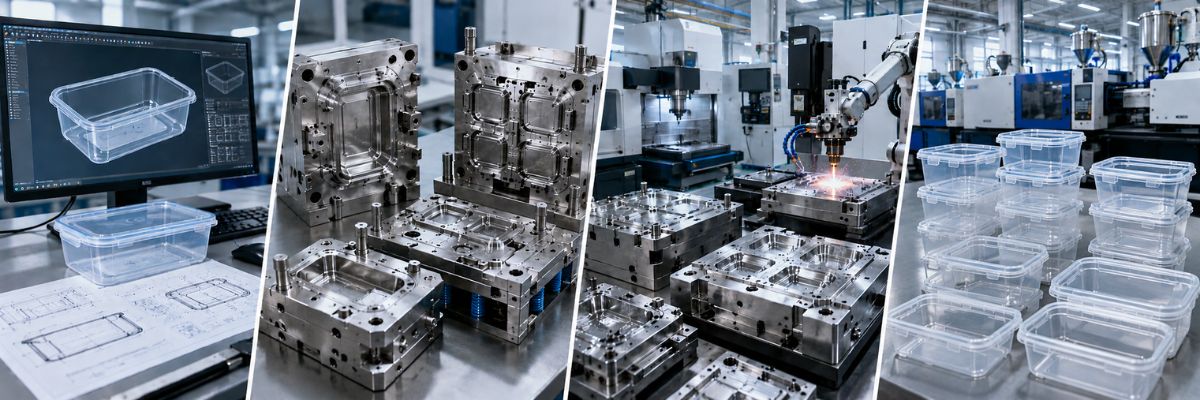
How a Precision Injection Mould Manufacturer Designs a Perfect Food Container Mould – Step by Step
Every plastic food container you use, from airtight lunch boxes to stackable kitchen storage containers, is created using a high-precision Plastic Injection Mould designed with extreme accuracy. Behind every durable, leak-proof, and perfectly shaped container is the expertise of a trusted Precision Injection Mould Manufacturer, where advanced engineering, precision machining, and quality-controlled mould making ensure consistent production and long-lasting performance.
If you are a product manufacturer, brand owner, or entrepreneur planning to launch a food container product, this guide walks you through every step of how a Plastic Mould Manufacturer like R. D. Mould & Industries designs and builds a food container mould from the first conversation to the final approved sample.
Understanding this process will help you ask better questions, avoid costly mistakes, and choose the right Plastic Mould Company for your product.
Why Food Container Moulds Demand Genuine Precision
Not every plastic part is technically demanding. But food containers are in a category that punishes imprecision immediately and visibly.
A lid that does not snap shut? Rejected by the consumer on first use. A container with uneven wall thickness? It warps when filled with hot food. A parting line with flash? It collects bacteria and fails food safety standards. A poorly cooled mould? The containers come out bowed and unusable.
This is why food container tooling is not a job for a general toolmaker it requires a dedicated Plastic Mould Manufacturer who understands the specific engineering demands of thin-wall houseware products.
R. D. Mould & Industries has been manufacturing Plastic Round Food Container Moulds and Plastic Square Food Container Moulds for over 22 years. The process below is how they approach every new food container mould project.
Step 1 – Product Evaluation and Cost Analysis
The process starts before any design work begins. When a client submits a product drawing, sketch, or physical sample, the team at R. D. Mould & Industries conducts a structured evaluation:
- What are the container dimensions and wall thickness?
- What plastic material will be used: PP, HDPE, PET, or food-grade ABS?
- What is the target production volume per year?
- Is a lid required as a matched mould, or a separate tool?
- Are any snap-fit features, stacking ribs, or branding embossments required?
Based on this evaluation, a detailed cost analysis report is prepared within 48 hours, covering recommended cavity count, mould base size, steel grade, estimated lead time, and pricing. This is the point where many buyers discover that a single-cavity mould makes no economic sense at their production volume, and that a 4-cavity or 8-cavity tool is the smarter investment.
Step 2 – DFM Review (Design for Manufacturability)
This is the step that separates a genuine Precision Injection Mould Manufacturer from a shop that simply cuts whatever drawing the client provides.
DFM – Design for Manufacturability is a structured engineering review of the product design before any steel is touched. The Mould Designing Team at R. D. Mould & Industries examines:
Wall thickness uniformity: Food containers typically have walls between 0.8 mm and 1.5 mm. Uneven thickness causes differential cooling, which causes warpage. If the product design has thick sections adjacent to thin ones, the DFM review flags it and recommends corrections.
Draft angles: Every vertical wall of a food container needs a small draft angle, typically 1° to 2°, so the part can be ejected cleanly from the mould without drag marks or distortion. Many first-time product designers omit draft angles entirely. DFM catches this.
Gate location: The gate is where molten plastic enters the mould cavity. For round containers, a centre gate at the base produces the most even filling. For square containers, a fan gate or multiple pin gates on the base perimeter may be more appropriate. Wrong gate placement causes weld lines, sink marks, and uneven fill, all visible and all unacceptable in a food-contact product.
A DFM review is not optional overhead. It is the most cost-effective step in the entire process, because fixing a design problem on screen costs zero. Fixing it after the mould is machined costs tens of thousands of rupees.
Step 3 – 2D and 3D Mould Design
Once the DFM review is complete and the client approves any recommended design changes, the mould designing service team creates the full mould design in CAD software.
For a food container mould, this includes:
Cavity and core design: The cavity is the female form (outside surface of the container). The core is the male form (inside surface). Both are machined to exact dimensions, with all features, ribs, logos, stacking geometry, and draft angles incorporated.
Cooling system layout: This is where a truly skilled Plastic Die Maker earns their fee. The cooling system channels drilled through the mould plates through which temperature-controlled water circulates determine how fast the part solidifies.
Ejector system: Ejector pins push the finished container out of the mould when it opens. Their number, diameter, and placement are carefully chosen so that the ejection force is distributed evenly, so that no single pin punches through a thin wall or leaves a deep witness mark on the container base.
All designs are shared with the client for review and approval before machining begins. This approval step is critical it is the client’s last opportunity to request changes before steel is cut.
Step 4 – Steel Selection and Procurement
A Plastic Mould Company that does not discuss steel grade with you before starting work is a red flag. For food container moulds, the choice matters enormously:
P20 pre-hardened steel is suitable for moderate-volume moulds (up to 500,000 shots). It machines easily and costs less. For a new product launch where volumes are uncertain, P20 is often the practical starting choice.
S136 stainless steel is the premium choice for food-contact applications. Its corrosion resistance means no rust contamination on food-contact surfaces, and it polishes to a mirror finish that exceeds food safety standards. R. D. Mould & Industries recommends S136 for all food containers that will contact wet or oily foods directly.
Step 5 – Mould Assembly
Once all components are machined, the complete mould is assembled: cavity plate, core plate, ejector assembly, cooling system connections, guide pillars and bushings, and all fasteners. At this stage, the assembled mould is checked for smooth operation. The mould opens and closes by hand, ejectors move freely, and the parting surfaces mate correctly with no high spots or gaps.
Assembly is where precision machining pays off. If individual components are dimensionally correct, they assemble correctly. If any component is out of tolerance, the assembly stage reveals it before a trial shot is wasted.
Step 6 – Hardening and Surface Treatment
Selected components, particularly the cavity inserts for high-volume moulds, are sent for heat treatment to increase hardness. For S136 stainless steel cavities, vacuum hardening is used to achieve the target hardness while maintaining dimensional stability.
After hardening, a final polish restores the cavity surface finish to specification. This step is non-negotiable for food container moulds where surface appearance is a product quality standard.
Step 7 – Mould Trial and Sample Approval
This is the proof-of-concept moment every Plastic Mould Manufacturer must deliver on. The assembled mould is mounted on an injection moulding machine, and the first trial shots are run.
At R. D. Mould & Industries, the mould trial for food container moulds evaluates:
- Dimensional conformance: Are the container dimensions within the specified tolerances? Is the lid-to-container fit within the target snap force?
- Surface quality: Are there any sink marks, weld lines, flow marks, or short shots?
- Warpage: Are the container base and walls flat after ejection and cooling?
- Ejection behaviour: Does the part release cleanly without distortion or drag marks?
- Cycle time: Does the mould run at the target cycle time with consistent part quality?
Sample containers from the trial are measured, photographed, and submitted to the client for approval. Any deviations are corrected by adjusting processing parameters, polishing, modifying gate dimensions, or adjusting ejector travel before the mould is signed off.
Step 8 – Packaging, Documentation, and Delivery
An approved mould is treated with anti-rust coating on all machined surfaces, wrapped in protective material, and securely packed for delivery. Every mould leaves the facility with a documentation package that includes mould drawings, steel material certificates, inspection records, and trial sample photographs.
This documentation matters. It is the basis for future mould maintenance, cavity repairs, and any steel modifications required when the product design evolves.
Why Choose R. D. Mould & Industries as Your Food Container Mould Manufacturer?
Established in 2002, R. D. Mould & Industries is a trusted Precision Injection Mould Manufacturer and Plastic Die Maker based in Ahmedabad, Gujarat. With over 500 unique mould designs delivered across India, they bring category-specific expertise that generic toolmakers cannot match.
Every food container mould project at R. D. Mould & Industries is backed by:
- Free DFM review before machining begins
- In-house 2D/3D mould design by experienced engineers, see their Mould Designing Service
- Full toolroom capability: CNC, EDM, grinding, polishing, and in-house trialling
- Three-stage quality inspection before delivery
- Export-quality moulds with complete documentation
- Post-delivery support for mould adjustments
If you are ready to discuss your food container mould project, Contact R. D. Mould & Industries today. A detailed cost analysis with steel recommendation, cavity count, and lead time will be ready within 48 hours.
Phone: +91 97242 35313 | +91 82388 55001
Email: info@rdplastmould.com
Address: 34, Arihant Estate, Odhav Ring Road Circle, Odhav, Ahmedabad, Gujarat – 382415